
Do Private Schools Provide Transportation?
- andreenlawson6
- Apr 29
- 5 min read
At 2:45 p.m., the school day may be over, but for many parents the real scheduling problem is just starting. If you are asking, do private schools provide transportation, the honest answer is: sometimes - but not always in the way families expect.
Private schools handle transportation very differently from public school systems. Some operate their own buses. Some contract limited routes. Some only offer transportation from central pickup points. Others provide no transportation at all and leave drop-off, pickup, and aftercare transfers entirely to families. That variability is exactly why parents need clear answers before enrolling.
Do private schools provide transportation in every case?
No. Private schools are generally not required to provide transportation the way many public school districts are. Because they operate independently, each school sets its own transportation policies, service areas, schedules, and fees.
That means two schools a few miles apart may have completely different setups. One may run morning and afternoon bus routes for multiple neighborhoods, while another may expect every family to handle transportation on its own. In South Florida, where traffic, distance, and after-school scheduling can change everything, those details matter quickly.
For parents, the key issue is not just whether transportation exists. It is whether the service actually fits your household routine. A school may say it offers transportation, but the route may not reach your area, may not align with your work hours, or may not include aftercare pickup.
What transportation options private schools usually offer
When private schools do provide transportation, it often falls into one of a few common models. The first is traditional school bus service, usually on a fixed route with designated stops. This can work well for families who live along the route and have enough flexibility to meet the bus on time.
Another common option is a shuttle or van service. These routes are often more limited and may serve only certain communities or regional hubs. Some schools create centralized pickup locations instead of door-to-school service, which reduces operating costs but adds another step for parents.
A third model is transportation tied to aftercare or extracurricular scheduling. In these cases, a school may offer afternoon transportation only at specific times, or only for students who remain on campus until a later dismissal window.
Then there are schools that maintain a list of outside providers or informal carpool groups rather than managing transportation directly. That arrangement can be helpful, but it is not the same as a school-operated service with direct oversight.
Why many private schools do not offer full transportation
Transportation is expensive and operationally complex. A private school has to account for vehicles, driver hiring, insurance, fuel, route planning, supervision, maintenance, and timing. For smaller schools, those costs can be difficult to absorb without raising tuition or adding separate transportation fees.
Geography is another challenge. Private schools often draw students from a wider area than neighborhood public schools. A single campus may serve families across multiple cities, making efficient routing much harder. A route that helps one family may add too much drive time for another.
There is also the issue of schedule complexity. Parents may need morning drop-off, regular dismissal pickup, aftercare pickup, sports transfer support, or seasonal options like summer camp transportation. Many schools are not set up to manage that level of recurring customization.
What parents should ask before relying on school transportation
If transportation is a deciding factor, ask specific questions early. General statements like "we offer bus service" do not tell you enough.
Start with the route itself. Ask whether service reaches your home, your neighborhood, or only a centralized stop. Confirm the estimated pickup and drop-off times, because a route that starts too early or ends too late may not solve your workday problem.
Next, ask about consistency. Are the same drivers assigned regularly? Is there direct communication if a route is delayed? How are children checked in and out? If your child is younger, ask what supervision looks like during loading and unloading.
You should also ask about aftercare and activity coverage. Many parents discover too late that school transportation only applies to standard dismissal, not to clubs, tutoring, or late-day programs. If your child stays after school even a few days a week, transportation has to match that reality.
Finally, ask how fees work. Some schools include transportation in tuition, but many charge separately. Others charge by route, stop, distance, or number of children. A lower tuition number does not always mean lower overall transportation costs.
The hidden gap between "available" and "workable"
This is where many families get stuck. A school may technically provide transportation, but the service may still leave major gaps.
For example, a bus stop may be 15 minutes from home in the opposite direction of your commute. Morning pickup may be reasonable, but afternoon drop-off may happen before a parent or caregiver is available. The route may not support aftercare at all. Or the service may be so broad that ride times become too long for younger students.
In practice, parents are often not asking only, do private schools provide transportation. They are asking whether transportation is safe, predictable, and built for real family schedules. Those are different questions, and they deserve different answers.
When a private student transportation service makes more sense
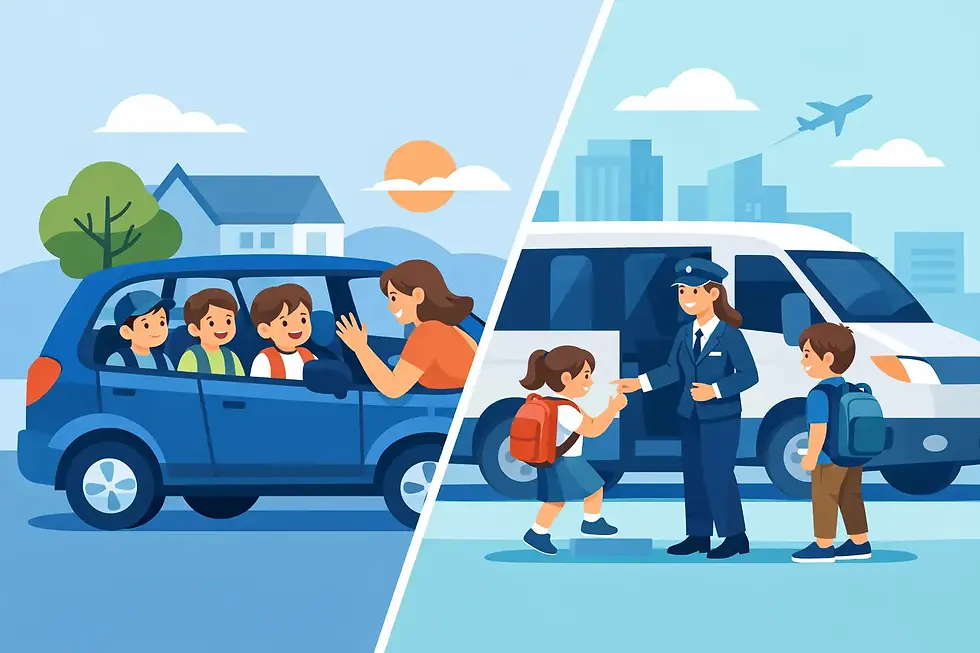
For families with tight work schedules, split households, multiple children, or recurring aftercare needs, a specialized student transportation provider can be a better fit than a limited school route. The advantage is not just getting from point A to point B. It is having a structured service designed around recurring school logistics.
A purpose-built student transportation company can often provide route planning based on your address, your child’s school, and your required schedule. That matters when your school does not offer transportation, offers only partial coverage, or cannot support after-school transitions.
There is also a trust factor. Parents looking for daily school transportation usually want more than a casual ride arrangement. They want screened drivers, proper licensing and insurance, routine communication, and a service model centered on children rather than general passengers.
That distinction is especially important when comparing private student transportation with informal carpools or app-based rides. Convenience alone is not enough when the ride is part of your child’s daily routine.
Do private schools provide transportation in South Florida?
In South Florida, the answer is especially mixed. Some private schools do offer bus or shuttle programs, but service areas, costs, and availability can vary widely. Traffic patterns, long cross-city commutes, and heavy after-school activity schedules often make school-operated transportation harder to maintain at a level that works for every family.
That is why many parents in Pembroke Pines and nearby communities look beyond the school itself when building a reliable routine. They may need transportation that covers school arrival, regular dismissal, aftercare pickup, or even summer camp rides once the school year ends.
When transportation becomes part of a family’s weekly operating system, reliability matters more than labels. Whether the ride comes from the school or from a dedicated provider, the standard should be the same: safe, consistent, professionally managed, and aligned with your child’s real schedule.
How to choose the right option for your family
The best choice depends on your child’s school, your location, and how much flexibility your household has. If the school offers a route that is safe, punctual, and compatible with your day, that may be enough. But if the service is limited, inconsistent, or incomplete, it can create more stress than it removes.
Look at the full picture. Consider pickup windows, commute time, driver oversight, communication, aftercare coverage, and what happens when plans change. Transportation is not a small detail in school planning. It affects attendance, punctuality, family routines, and peace of mind every single day.
For families who need a more dependable option, a specialized provider like JOLLIBUS can fill the gap with structured student transportation designed around recurring school needs. That kind of support is often what turns a difficult routine into a manageable one.
The better question is not just whether private schools offer transportation. It is whether your child has a ride plan you can trust on a busy Tuesday morning and an even busier Thursday afternoon.


Comments