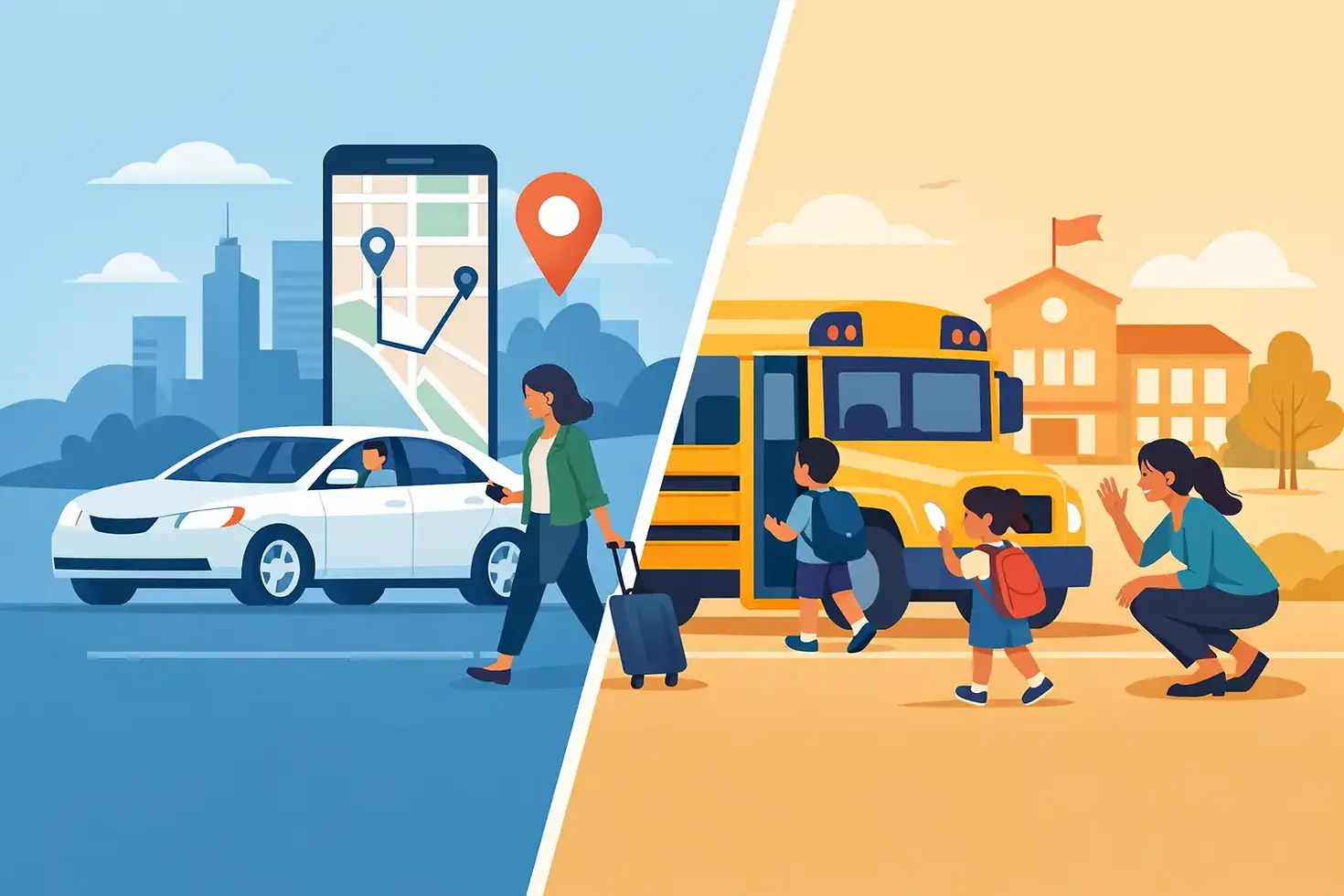
Rideshare vs School Commute Service
When a school pickup falls right in the middle of a work meeting, the difference between rideshare vs school commute service stops being theoretical. It becomes a daily decision about who is picking up your child, how predictable that ride will be, and whether you can count on the same level of care every afternoon.
For many South Florida families, transportation is not just about getting from one address to another. It is about routine, trust, and avoiding the stress that comes from last-minute backup plans. While rideshare apps may look convenient on the surface, a school-focused commute service is built for a very different job.
Rideshare vs school commute service: what is the real difference?
A standard rideshare service is designed for broad public use. It helps adults get around on demand, often with different drivers, different vehicles, and changing availability depending on time of day and demand. That model works well for many everyday trips, but school transportation asks for more structure than a typical on-demand ride is meant to provide.
A school commute service is built specifically around recurring student transportation. Instead of treating each ride as a one-time request, it is designed around a family’s schedule, a child’s school, and the need for consistent pickup and drop-off procedures. That difference matters because children are not casual passengers. Their transportation requires planning, accountability, and a system parents can rely on day after day.
The most practical way to think about it is this: rideshare prioritizes convenience for the general public, while a school commute service prioritizes dependable transportation for students.
Safety standards are not the same
For parents, safety is usually the first question and the right one. Not every transportation model is built with children as the primary focus, and that affects how the service is structured.
With rideshare, the platform is typically built around adult riders requesting trips when needed. Even if a ride is available quickly, that does not automatically mean the service was designed around school-aged passengers, recurring student pickups, or the level of operational oversight families want for daily school transportation.
A dedicated school commute service is different by design. It centers child transportation from the start, which usually means clearer driver screening standards, stronger operational controls, and more defined pickup and drop-off expectations. Parents are not simply looking for a driver. They are looking for a transportation partner that understands school routines, aftercare timing, and the responsibility of transporting children consistently.
That does not mean every rideshare trip is unsafe or every school commute provider is identical. It means parents should look at how the service is built, what safeguards are in place, and whether children are the intended core passenger group rather than an occasional use case.
Reliability is where the gap gets wider
The biggest issue for many families is not only safety. It is consistency.
Rideshare availability can change based on demand, traffic, driver supply, weather, and surge periods. A ride that seems easy to book one morning may be harder to secure the next afternoon. For an adult heading to dinner, that may be inconvenient. For a parent trying to make sure a child is picked up from school or aftercare on time, it can create real stress.
A school commute service is structured around recurring transportation needs. Routes are planned in advance. Schedules are known. Pickup and drop-off expectations are clearer because the service is built around repeat trips, not random demand. That level of structure can make a major difference for working parents managing school hours, job responsibilities, and household logistics.
Consistency also helps children. Familiar routines reduce confusion, especially for younger students who benefit from predictable transitions between school, aftercare, and home. When transportation is organized around the same plan each week, the day tends to run more smoothly for everyone involved.
Oversight and communication matter more than most parents expect
One of the hidden differences in rideshare vs school commute service is how much visibility a family has into the transportation process.
With general rideshare, communication is often centered on a single trip. You may see where the vehicle is and when it is arriving, but the service is not always designed for ongoing parent communication around recurring school transportation. That can leave gaps when schedules change, aftercare pickup instructions differ, or a parent needs assurance that a child has been safely received and dropped off.
A student transportation service is more likely to treat communication as part of the service itself. Real-time ride updates, planned scheduling, and clearer coordination around family routines are not extras. They are part of what makes the service useful. Parents need more than an estimated arrival time. They need confidence that the ride is operating within a system built for student accountability.
That kind of oversight becomes especially valuable when life gets busy. A delayed meeting, a childcare handoff, or a change in after-school plans is easier to manage when the transportation provider is accustomed to structured family coordination.
Cost is not always as simple as it looks
At first glance, rideshare can seem like the more flexible option. You book when needed and pay per trip. For occasional transportation, that may work fine.
But school transportation is rarely occasional. It is recurring, time-sensitive, and often tied to two working adults or a caregiver balancing multiple commitments. Once a family starts using transportation several times a week, the comparison shifts. Parents are not only paying for miles. They are paying for predictability, reduced last-minute scrambling, and fewer disruptions to work and family schedules.
A school commute service may involve route planning and a personalized quote, but that model often reflects the fact that the service is designed around ongoing support rather than casual use. For families who need dependable transportation week after week, value often comes from reliability and peace of mind as much as from raw trip cost.
The right question is not simply which option looks cheaper in one moment. It is which option better supports your household over time.
Which families may prefer rideshare?
There are cases where rideshare may feel like the practical choice. If transportation needs are rare, inconsistent, or limited to adult family members, on-demand convenience can make sense. Some households only need occasional backup transportation and may not require a recurring route-based service.
Even then, parents should be realistic about what problem they are trying to solve. If the issue is a once-in-a-while scheduling conflict, a flexible option may be enough. If the issue is repeated school pickup pressure, aftercare transitions, or daily transportation strain, then a general rideshare model may not be the strongest long-term fit.
Which families benefit most from a school commute service?
Families with recurring transportation needs usually see the clearest advantage. That includes households with fixed work schedules, split pickup responsibilities, aftercare transitions, or multiple weekly trips that need to happen on time without constant rebooking.
A school commute service is especially helpful when parents want more than a ride. They want consistency, vetted drivers, scheduling built around school needs, and communication that supports peace of mind. In those situations, transportation becomes part of the family’s routine, not another unpredictable task to manage.
For many parents in Pembroke Pines and across South Florida, that structure is the difference between getting through the week and constantly adjusting to it.
How to choose the right fit for your child
If you are weighing rideshare vs school commute service, start with three questions. First, is this a recurring need or a temporary one? Second, do you need a ride, or do you need a system you can trust every school day? Third, how much does consistency matter for your child’s routine and your own schedule?
The answers usually make the right option clearer. If your household needs dependable school and aftercare transportation with professional oversight, recurring scheduling, and child-focused service, a dedicated student transportation provider is often the better fit. That is why many families turn to services like JOLLIBUS when casual transportation stops meeting the demands of real school routines.
Parents carry enough every day. Your transportation plan should remove pressure, not add to it. The best choice is the one that lets your child get where they need to go safely and lets you move through the day with more confidence.


Comments